Every human being is born into this world helpless; the immensity of the soul with its entire potential, its wisdom, seems to be trapped in a small and helpless baby-body. It is a crucial moment, because as a newborn baby, we are dependent and in constant
need of being taken care of, which causes our first experience in life to be one of extreme vulnerability. This sense of vulnerability, which is the energy of the 'Inner Child', is still very close to our original sense of uniqueness, of who we truly are. As such, it is the doorway to our Essence. Growing up and developing the many parts of our personality that protect the vulnerable Inner Child, the child energy gets
buried; we lose the connection with Essence to a large extent. In order to survive in this world, we need to develop a certain power and hide our vulnerability. The Inner Child energy is the part in us that has an extremely fine-tuned sensitivity to the moods of people and is able to detect the slightest changes in the atmosphere around us. It is the part in us that enables us to be truly intimate with others. Therefore,
it's important to rediscover this part in ourselves in the course of the inner work we do. On the other hand, the strong parts of our personality stand between us and our deeper contact with other people. Having our vulnerability and our Inner Child energy available to us enriches our relationships. It seems a paradox. We need our strong parts to get along in life, but we also need to wake up to who we really are and stop being just the strong parts, in order to be whole again.
Blocking the vulnerability blocks the passageway to our core being. Each year on the first day of our five-day training, we give all the participants a raw egg to carry with them - day and night - for the duration of the training, as a symbol of the vulnerability of their inner child.
Carrying the egg on their body helps them remember, both mentally and physically, how vulnerable they are in many different
situations, including on a physical level. They become more sensitive to the needs of their own 'Inner Child' as well as the needs of other people; they become more caring, which expresses itself in opening a door for someone or getting them a cup of tea. Even hugging becomes an act of conscious holding, respectful of the boundaries that are so easily trodden over.
|
|
|
|
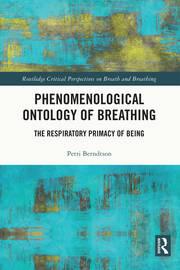
Wilfried Ehrmann interview with Petri Berndtson
Wilfried: When did the idea come to you, to see breathing as the root of all being? When I first heard this approach, I thought it was crazy and audacious. Petri: The idea came in 2006, when I worked on my master thesis on breathing, and read Luce Irigaray’s book: "The Forgetting of Air in Martin Heidegger“. In the beginning, I did not think about ontology, although Heidegger
was famous for his phenomenological ontology, so I received some seed. Then I found an article by David Michael Levin on “Logos and Psyche - A Hermeneutics of Breathing”. In Heidegger’s book "Being and Time“ (Sein und Zeit) anxiety plays an important role and he very briefly mentions that it is connected with shortness of breath. Some psychologists like Fritz Perls, founder of gestalt therapy noticed the disturbance of breath due to anxiety. In his article, Levin says that Heidegger
phenomenological analysis of Angst is short-sighted, because it does not go into the question of breathing. In „Being and Time“, there is only one sentence on breathing. In it Heidegger connects anxiety with a stifling of the breathing. Levin also talks about the respiratory body mentioned by Maurice Merleau-Ponty. According to Merleau-Ponty the respiratory body gives us the first experience of space. Levin concluded that the breathing body is our first openness to being. These ideas were the
seeds for me, and then little by little at the end of my Master Thesis I felt that I had some ideas which I had never seen before, and I felt in a sense that it is my moral duty and responsibility towards humanity to explore these insights. When I started my work for my PhD, it was not yet about ontology, but in the second year it went onto ontology. Then I found a quote from Merleau-Ponty, although he never explains what it means: „There is really and truly inspiration and expiration of being,
respiration within being.“ In connection with the quote from Levin, it becomes clear that the respiratory body is the first opening to being. When Heidegger says "Es gibt Sein“ (“there is being”), and this is the first truth, from where all other truths open up, so I thought, maybe there is a secret hidden in these in these phrases by Merleau-Ponty and Heidegger . In 2008 I found Gaston Bachelard’s book "Air and Dreams“,
and I intertwined the ontological thoughts of Heidegger and Merleau-Ponty with Bachelard and a few ideas from Irigaray and Levin. The bringing together of these thinkers gave me an understanding that a phenomenological ontology of breathing could contain incredible possibilities.
|
|
|
|
|
Cultivating Presence and Therapeutic Excellence through Deep Training Keynote Lecture by Tilke Plateel-Deur at GIC 2024 in the Netherlands
Because the therapeutic bond in Breathwork Therapy is extraordinary, merging emotional closeness with an intimate physical connection, guiding another human being through
this deeply transformative process, we need to develop a profoundly balanced personality. In essence, 'Breathwork Mastery' involves a journey from unbridled enthusiasm to a nuanced understanding, stressing the need for extensive training. As well as cautioning against the pitfalls of inadequate preparation in the evolving field of Breathwork. -
Universal Love - Basis of a Therapeutic Relationship in Breathwork In any therapeutic relationship the foundation lies in establishing an authentic connection with individuals, by recognizing the inner resources within each human being, to lead a creative and spiritually fulfilled life.
Any therapeutic bond is nothing short of exceptional, rooted in profound respect, support, unwavering acceptance, and love.
Unlike other therapeutic relationships, Breathwork takes it a step further, merging emotional closeness with an intimate physical connection. We are breathing together! The result? A relationship that is not just whole but holy and sacred.
Love is meant here as Universal Love, a topic that has been debated by philosophers and theologians during many centuries. Universal Love often might seem impracticable or
logically impossible.
Buddhism, Christianity, and other belief systems invite us to practice compassion, kindness, and love towards all beings, as a way to transcend egoism.
Universal Love may be challenging to achieve in practice. Nevertheless, it supports us to cultivate empathy, compassion, and understanding towards others. Exactly what we need to work therapeutically with other people.
It's the basis for a good therapeutic relationship in Breathwork sessions!
This Takes
Time!
|
|
|
|
|
|